CCGA, GCSS reach out to help special education, traditional students
听
By ANNA HALL The Brunswick News | Posted: Tuesday, September 8, 2015 12:00 am
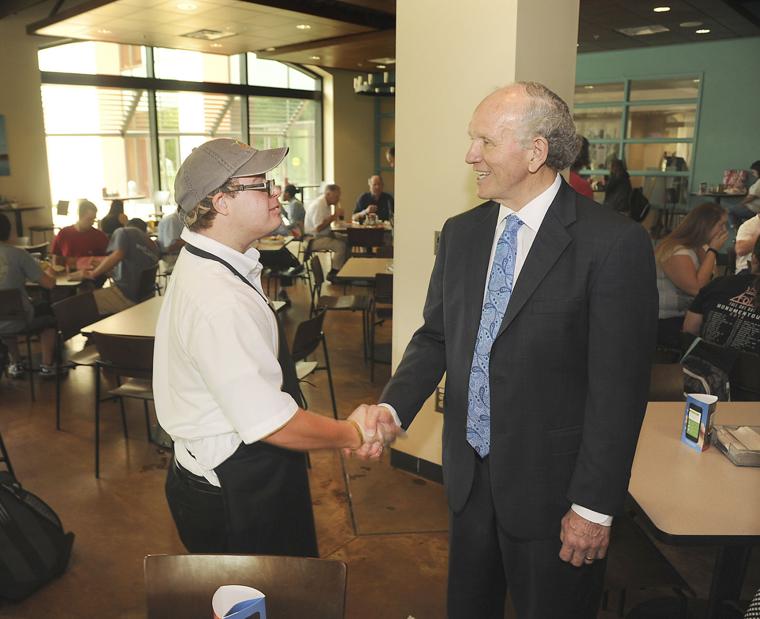
REACH Program
海角社区 President Greg Aloia shakes hands with Emory Hatcher, a student in the REACH program currently working in The Mariners Galley on campus.
Reaching out to shake hands with several individuals contributing to his growing popularity on campus, Emory Hatcher grinned his signature bright grin and nodded in his signature sign of respect.
鈥淕ood afternoon, sir, good afternoon,鈥� Hatcher said, speaking with 海角社区 President Greg Aloia.
Every day, Hatcher can be found in the college鈥檚 central hub of activity, working in the college鈥檚 cafeteria, mingling with students and performing his daily duties in the food service department, which includes wiping down tables and helping with clean-ups.
鈥淓mory here is quite the social butterfly,鈥� Aloia said. 鈥淗e makes new friends here every day.鈥�
A 21-year-old Glynn Academy special education student, Hatcher is playing a lead role in a collaborative program between the county school system and the college to help special education students gain real world work and learning experiences.
These students are on the cusp of being ready for working environments but need a few extra years to further develop soft skills. Known as the Reaching Educational and Career Heights, or REACH, program, the effort is part of a national transition movement aimed at students with cognitive disabilities.
In Glynn County, the program is open to public students who have completed four years of high school, participated in a minimum of three years of job readiness training, and are between 18 to 21 years old, with mild to moderate intellectual disabilities.
Through the program, special education students prepare for the future through assessment and instruction both in the classroom and in the community. Work skills, work behaviors, community participation and independent living skills are the core efforts through the course.
Marilyn Capps, REACH program instructor for the Glynn sector of the program, recently went to Alioa to see about expanding the program to the college鈥檚 campus.
When she asked, she didn鈥檛 do it alone. Capps brought Hatcher along with her to demonstrate for Aloia the success of the two-year-old program. Instead of Capps asking administrators for permission to start up a partnership between the two schools, she let Hatcher do all the talking.
鈥淗ow can you say no to Emory? Pretty much, you can鈥檛,鈥� Aloia said. 鈥淗e has had such wonderful experiences through this program, and bringing his and his peers to our college is having impacts campuswide. This was a no-brainer for the college.鈥�
Six students are taking part in the college鈥檚 on-campus program. Meeting at 8:30 a.m. five days a week, Hatcher and his peers work four hours a day, five days a week. The students are not offered payment for their service because it is funded through the county school system, but they receive valuable hands-on learning experiences as well as a free on-campus meal, which Hatcher said is fine by him.
鈥淚 love the food,鈥� he said. 鈥淭he ribs are my favorite.鈥�
Prior to the expansion of the program to the college campus, students were being transported back and forth between Glynn Academy and the college. But now, the college serves as a home base for the students, both for their work hours and then for afternoon instruction.
It also provides students with college identification cards and invitations to attend sporting events and student activities, Aloia said.
While REACH students can be seen working in the food services and in the student bookstore, the program will eventually expand to other areas, such as groundskeeping and landscaping. The hope is to increase the number of students involved to 10, Aloia said.
For Aloia, the program hits especially close to home. His brother had spina bifida and was classified as a special education student, who was not permitted to attend public school, the policy in those days. Because of the exclusion, he was treated vastly different than other children, Aloia said.
鈥淭o me, he wasn鈥檛 handicapped. He was just my brother. We played and fought and did what brothers do,鈥� Aloia said. 鈥淏ut people stared at us, stared at him. We didn鈥檛 understand. We always asked our mother why people looked at us like that. It was a struggle.鈥�
That struggle is likewise a key reason the program was expanded to the college campus.
As much as it strives to help special education young adults develop soft working skills and proper social skills, it, too, will be a benefit to the college population.
Special education and disabled students are often treated differently in society, with individuals not knowing how to act around someone with such conditions. Seeing special education students on the Brunswick campus in daily settings will help college students overcome such mindsets and to see these individuals as peers, not outcasts, Aloia said.
鈥� Reporter Anna Hall听writes about education and other local topics. Contact her at听ahall@thebrunswicknews.com, on Facebook or at 265-8320, ext. 322.